
Drilling mud, also known as drilling fluid, is a critical component in oil, gas, and geothermal drilling operations. It is a specially engineered fluid circulated through the wellbore during drilling to ensure safety, efficiency, and well stability. Without drilling mud, modern drilling operations would face serious technical and environmental challenges.
In this article, we will explain what drilling mud is, explore the main types of drilling mud, and discuss their key applications in drilling operations.
Table of Contents
What Is Drilling Mud?
Drilling mud is a fluid mixture of liquids, solids, and chemical additives designed to perform several essential functions during drilling, including:
- Cooling and lubricating the drill bit
- Carrying drill cuttings to the surface
- Controlling formation pressure
- Stabilizing the wellbore walls
- Preventing formation damage
Depending on geological conditions, well depth, temperature, and environmental requirements, different types of drilling mud are selected.
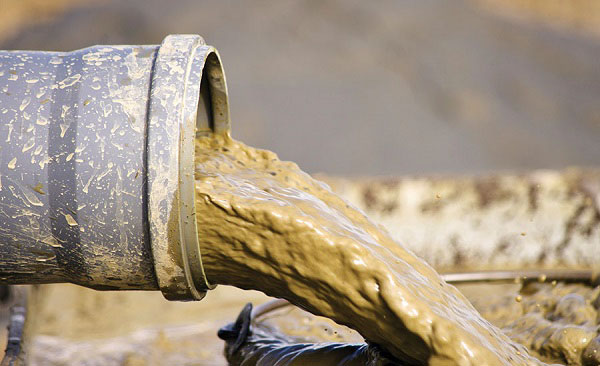
Applications of drilling mud
Applications of Drilling Mud:
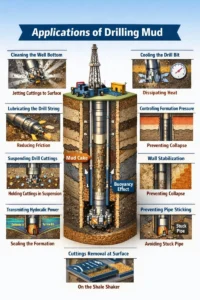
Preventing pipe sticking above drill collars (DCs)
Accumulation of settled cuttings above drill collars can cause the drill string to become stuck. In such cases, expensive fishing operations may be required to recover the equipment.
Cleaning the bottom of the well and transporting drill cuttings to the surface
When drilling mud exits the bit nozzles, its high-velocity jet cleans the well bottom effectively. This improves bottom-hole cleanliness, increases the drill bit’s service life, and enhances the rate of penetration (ROP).
Cooling the drill bit and drill string
Intense heat is generated at the bit–formation interface. The drilling fluid absorbs this heat and carries it to the surface, preventing overheating of the bit and drill pipes.
Lubricating the drill bit and drill string
The clay (bentonite) commonly used in most water-based drilling muds also acts as a lubricant, reducing friction between the drill string and the wellbore.
Coating the wellbore walls and preventing collapse
A good drilling mud should form a thin, impermeable filter cake on the wellbore walls, even in loose or unconsolidated formations. This coating prevents loss of mud and filtrate into the formation, improves wellbore stability, and helps prevent wall collapse.
Controlling subsurface pressures
During drilling, high-pressure zones such as water-bearing layers or pay zones may be encountered. The hydrostatic pressure exerted by the drilling mud column counterbalances these formation pressures and prevents kicks or blowouts.
Suspending drill cuttings and weighting materials when pumps are shut down
Separating cuttings and weighting materials on the shale shaker
A good drilling mud should allow drill cuttings and weighting agents to be easily separated when the fluid flows over the shale shaker screens at the surface.
Supporting part of the weight of the drill string and casing
Since drill pipes and casing are immersed in drilling mud, they are affected by the buoyancy effect of the fluid, which reduces their effective weight by an amount equal to the weight of the displaced mud volume.
Minimizing damage to surrounding formations and providing maximum geological information
Transmitting hydraulic power from pumps to the drill bit
Drilling mud serves as a continuous medium that transfers the hydraulic energy generated by the pumps directly to the drill bit.
Suspension capability during non-circulation periods
The ability of drilling mud to suspend cuttings during non-circulation depends on its gel strength, which indicates the mud’s thixotropic properties. This behavior must be reversible, meaning the gel should return to a fluid state when agitated.
Preventing cuttings from settling during pump shutdown
Suspending cuttings during pump shutdown prevents them from falling to the bottom of the well, which could lead to bit sticking and hardening.
Types of Drilling Mud
Choosing the right drilling mud type directly impacts drilling performance, cost control, and environmental compliance.
1. Fresh Water Muds
Fresh water muds are water-based drilling fluids where fresh water is used as the continuous phase. They are among the most commonly used drilling muds due to their simplicity and cost-effectiveness.
Key Features:
- Environmentally friendly
- Low cost
- Easy to prepare and maintain
Applications:
- Shallow wells
- Soft formations
- Areas with minimal salt contamination
2. Salt Water Muds
Salt water muds are water-based fluids that contain dissolved salts such as sodium chloride (NaCl). These muds are designed to minimize the interaction between water and salt-sensitive formations.
Key Features:
- Improved shale stability
- Reduced clay swelling
- Better control in saline environments
Applications:
- Drilling through salt formations
- Offshore drilling
- Formations sensitive to fresh water
3. Emulsion Muds
Emulsion muds consist of a mixture of oil and water, where one liquid is dispersed in the other using emulsifying agents. They can be either oil-in-water or water-in-oil emulsions.
Key Features:
- Enhanced lubrication
- Improved wellbore stability
- Better performance at higher temperatures
Applications:
- Complex geological formations
- High-temperature wells
- Directional and horizontal drilling
4. Oil Base Muds (OBM)
Oil base muds use oil as the continuous phase, with water dispersed as droplets. These muds offer superior performance in challenging drilling conditions.
Key Features:
- Excellent thermal stability
- Strong resistance to contamination
- Superior lubrication properties
Applications:
- High-pressure, high-temperature (HPHT) wells
- Reactive shale formations
- Extended-reach and horizontal wells
Note: Due to environmental concerns and higher costs, oil base muds are typically used only when necessary.
5. Surfactant Muds
Surfactant muds contain surface-active agents that modify fluid behavior by reducing surface and interfacial tension. These muds improve fluid performance in specific drilling conditions.
Key Features:
- Enhanced cleaning efficiency
- Improved cuttings removal
- Reduced formation damage
Applications:
- Wells with poor hole cleaning
- Complex fluid systems
- Specialized drilling operations
Conclusion
Drilling mud is far more than just a fluid—it is a carefully engineered system essential for successful drilling operations. From fresh water muds to oil base and surfactant muds, each type serves a specific purpose based on geological and operational requirements. Understanding these mud types helps engineers and operators make informed decisions that lead to safer, more efficient drilling projects.






Leave a Reply